
In September 2023, I was approached by President Kannan and Scientific Officer Shiva about piecing together a “Frogs of Singapore” poster, the first of its kind here on our tiny island nation. It was an amazing idea since frogs are much harder to identify, and many people often struggle to identify similar-looking species. Trust me, I’ve been there. After a quick Zoom call to flesh out ideas and discuss the feasibility of this project, I swiftly accepted the challenge of putting this poster together with fellow HSS member Gabrielle.
Unlike snakes, frogs tend to remain unperturbed by the presence of humans, especially if they believe their camouflage is effective. This meant that photographing them would not be as much of a challenge. However, we were faced with other difficulties, especially when it came to cutting out the frogs’ photographs for this poster. The process was meticulous; we needed to ensure that there were no obstructions on their bodies and that any we found were edited out. We had to ensure that each cutout was clean and precise.

Locating them, however, would be tricky as many rare species were tucked away in hidden corners of our forests. Moreover, the deadline was set as the 2024 Festival of Biodiversity on the 25th of May, meaning that we had less than eight months to put it all together.

The first step was to check what we already had. In our short few years of herping, we could clock some species locally, including several rarities, which left us with about 20 remaining species to find and photograph.

We crossed off some common frogs quickly, e.g., Banded Bullfrog (Kaloula pulchra) and Field Frog (Ferjervarya limnocharis), but soon found ourselves stumped with the rarer frogs. One such example was the Lim Boo Liat’s Sticky Frog (Kalophrynus limbooliati), which required a 7 am trip down to the Bukit Timah Nature Reserve to find.
Within the herping community, frogs often go underappreciated, with snakes usually stealing the limelight. Nevertheless, they play a crucial role in the ecosystem, serving as ecological indicators and thus providing insight into how well an ecosystem functions. Frogs are secondary consumers in the food web, preying on invertebrates and even other smaller frogs, all while being preyed on by larger animals such as snakes. In Singapore, we have 30 species of frogs, some of which people may have never seen or heard about before.
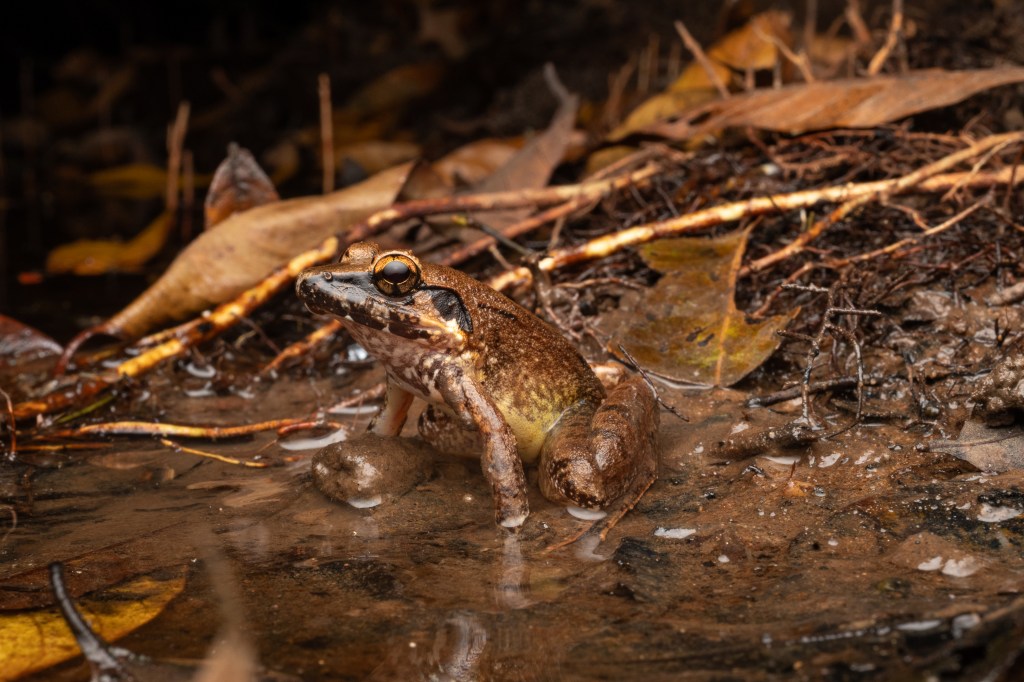

Other difficult frogs included species with highly specific microhabitats, such as the swamp forest-dwelling Masked Swamp Frog (Limnonectes paramacrodon).
As we wanted to include the non-native frogs, the American Bullfrog (Aquarana catesbeiana) also had to be included in the poster. Previously, we had seen released juveniles at the Rail Corridor and Pasir Ris mangroves, but we needed a large adult to provide some context to its size. To accomplish this, I contacted the people from the Jurong Frog Farm, who kindly invited me to come down to their booth at an event held at Qian Hu Fish Farm to photograph their specimens.
Fast forward a few months, and the poster is nearly completed, except for several rare species that can only be found in restricted areas in Singapore. They were the Manthey’s Chorus Frog (Microhyla mantheyi), Blue-spotted Tree Frog (Leptomantis cyanopunctatus), Inger’s Dwarf Toadlet (Pelophryne ingeri), Malayan Horned Frog (Pelobatrachus nasutus) and the Horrible Bug-eyed Frog (Theloderma horridum). Thankfully, our friends from HSS had photos of some of these rare species, which we could use to supplement our poster. We also flew over to nearby Peninsular Malaysia, where it was easier to procure photographs of the latter two species as they were more common there (see below).


With the final piece of the puzzle, the poster was completed just two weeks before the Festival of Biodiversity. We are incredibly proud to present the Frogs of Singapore poster, one we had worked tirelessly on, from finding and photographing the frogs to painstakingly cutting out each and everyone for the final product.
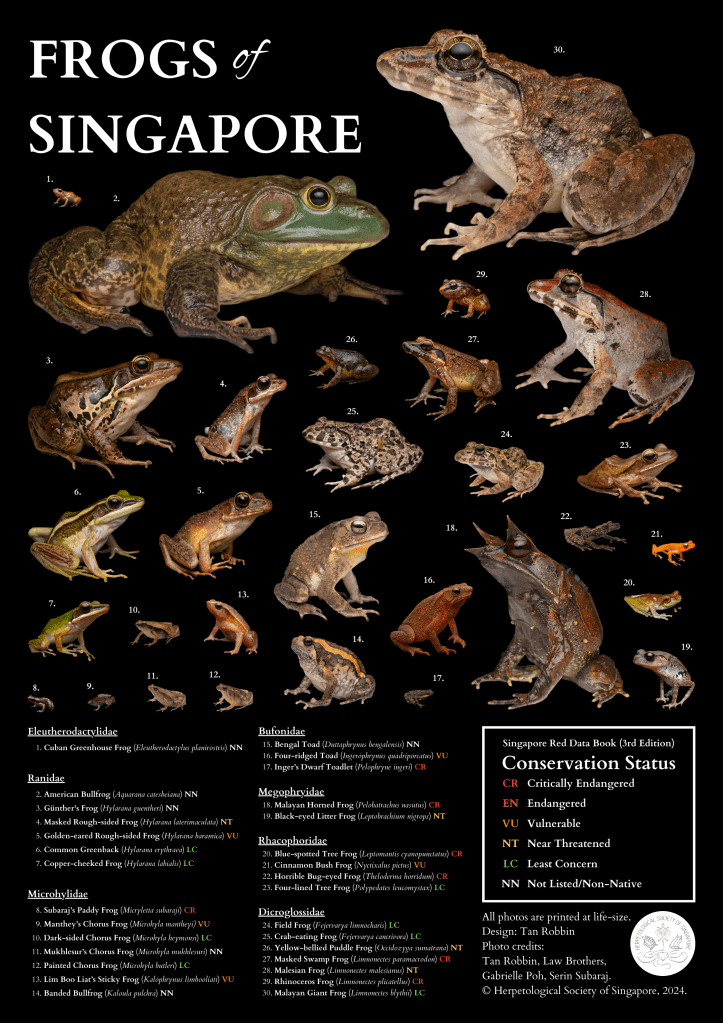
This would not have been possible without the support of HSS President Kannan and Scientific Officer Shiva, whose invaluable feedback guided the poster’s development at every phase. We would also like to thank the Law Brothers and Serin Subaraj for generously providing photographs of some of Singapore’s rarest frogs, for without them, we would not have been able to showcase all 30 species of frogs.
After travelling all over Singapore and Malaysia, we’ve gained a newfound appreciation for frogs and further improved our audio and visual identification skills through this meaningful project. We hope this poster is not just aesthetically pleasing on your walls but also helps expand your knowledge and awareness of Singapore frogs.
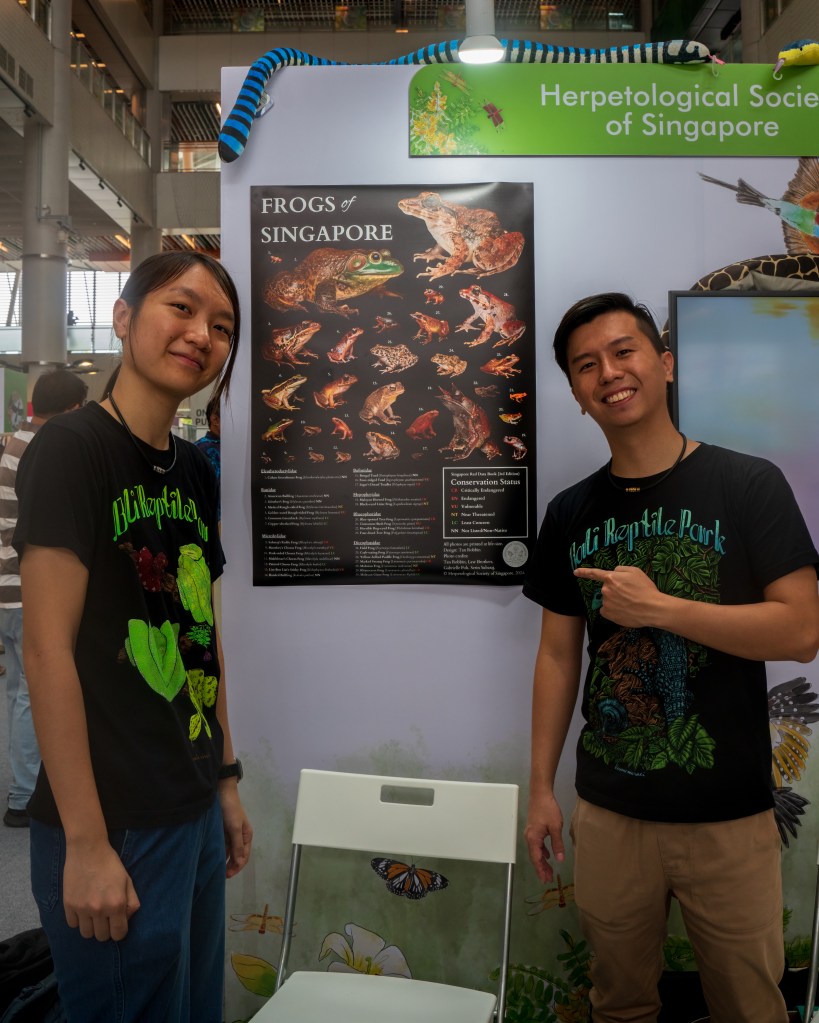
And if you’d like to get your own copy of the Frogs of Singapore poster, just click here!
Author: Tan Robbin
Photos: Tan Robbin and Gabrielle Poh
HSS Members
References
Sankar, A., Law, I. T., Law, I. S., Shivaram, R., Abraham, R. K., & Chan, K. O. (2022). Morphology, phylogeny, and species delimitation of Micryletta (Anura: Microhylidae) reveals a new species from Singapore. Vertebrate Zoology, 72, 457–467. https://doi.org/10.3897/vz.72.e85020
Tan, R., Lai, E. A., Nonis, R., Poh, G. F. F., & Chai-Parikh, I. (2023). Biodiversity Record: Subaraj’s paddy frog at Kranji. Nature in Singapore, 16, 1. https://doi.org/10.26107/NIS-2023-0086
 Herpetological Society of Singapore